

The TRUTH about Getting In, Getting Signed, and Getting Ahead (PLUS Everything I shouldn't have said in my Live Q&A but did anyway...)
Alex is the Managing Director of major UK talent agency InterTalent. He represents his clients alongside overseeing the agency's creative strategy, day-to-day operations & acquisitions.

Welcome to Dealmakers with Alex Segal ✍️, a Substack on the realities of being a talent agent, packed with weekly insights to keep you ahead of the game 🚀.
Having negotiated £40m+ in talent deals 💼 and grown company turnover 5x in 5 years 📈, I am sharing my experiences and knowledge of 17 years representing some of the biggest stars in the UK.
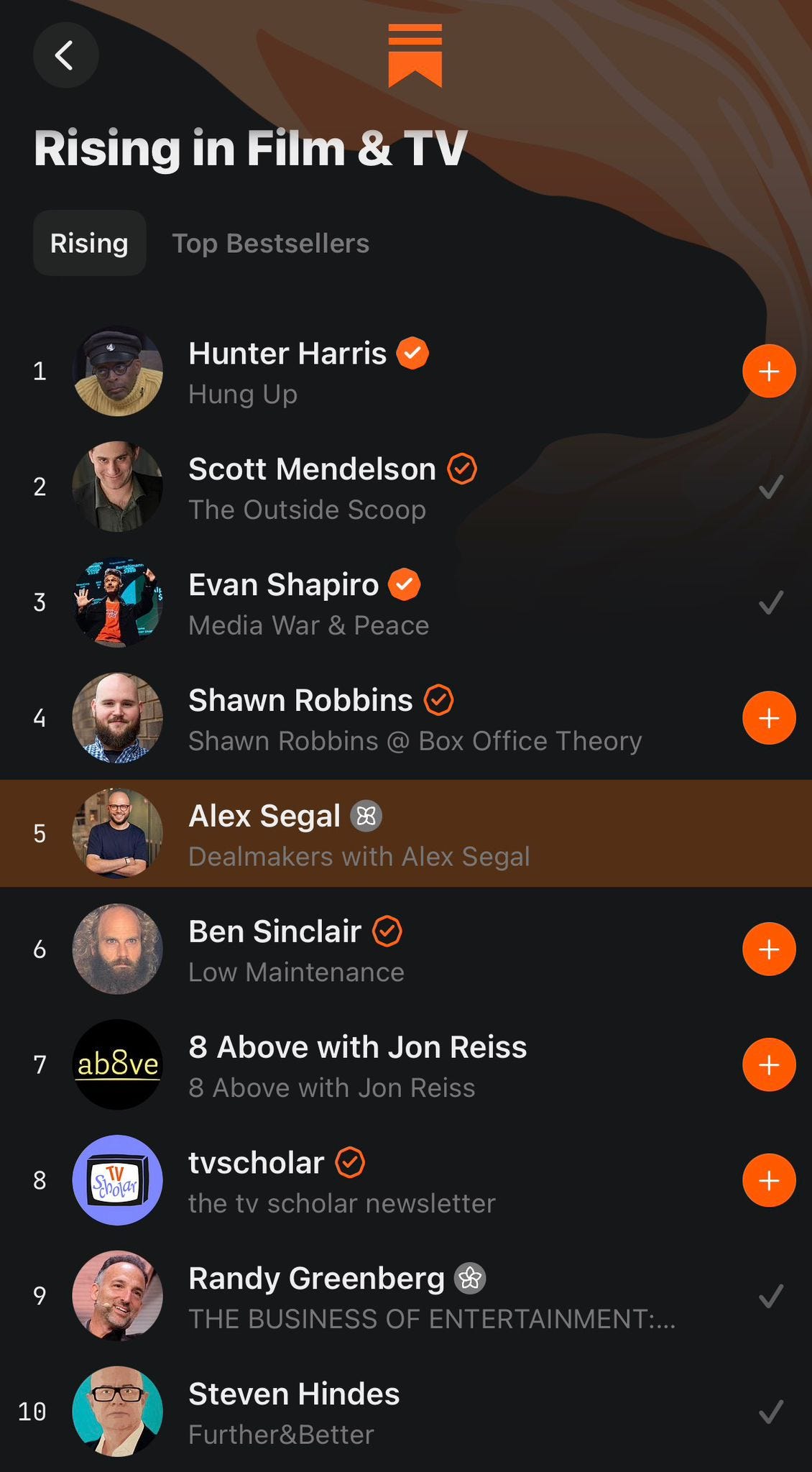
We’re now hitting 20,000+ monthly views 👀 and ranking as high as #5 in Substack’s Global Top 100 Rising TV & Film Newsletters list 🏆, so I really appreciate you taking the time to be here.
Dealmakers is read by key individuals at the BBC, ITV, Netflix, UKTV, Sky, Sony Music, and other major entertainment companies, as well as all of the UK’s leading talent agencies.
If you’re not already subscribing, please do so for free (or go paid for a whole lot more), and join everyone who gets Dealmakers straight to their inbox 📩.
Follow the brand new Dealmakers with Alex Segal WhatsApp channel to receive news, intel, advice & strategies straight to your phone.
I had the craziest notification pop up on my phone last week week.
In amongst the usual WhatsApps, emails, texts, and whatever else that comes our way constantly, I had this message pop up from Substack:
You are currently #5 Rising in Film & TV
I couldn't believe it.
This thing I started back in June 2023 as a way to a) share my experiences and knowledge with the younger generation and b) to finally give in to my desire to write something more creative than an email had made it as high as #5 in Substack's GLOBAL list out of all TV & Film publications.
Seeing my name alongside some of the most incredible writers in our industry, people I read every single day, is mind-blowing.
Thank you to everyone who has clicked Subscribe over the past few years. Dealmakers now receives 20,000 views per month, and this news has only given me more ambition to keep seeing where I can take it.
Since I started Dealmakers other unexpected things have also happened:
→ consulting for media companies, M&A companies, start-up talent agencies and many other businesses wanting to learn more about either the talent management space or the wider media & entertainment landscape in the UK.
→ being asked to appear on panels, industry podcasts, and write opinion pieces on the role of a talent agent and the latest goings on in entertainment.
→ interviewed about breaking news for BBC News, The Times, LBC, The Guardian and more.
→ having Dealmakers sponsored by companies who are looking to engage more with other talent agencies, agents, assistants and more.
→ being asked to take part in really fun and rewarding community and charity work, especially for young people in schools and universities looking for careers in media & entertainment.
I feel like we’re just getting started…
Last Wednesday, I hosted a Dealmakers Q&A where a really interesting and inquisitive group of people fired questions at me for over an hour. I asked the brilliant Siobhan James (her Substack is HERE) to moderate and we got through lots of topics.
It was a wide ranging conversation and I’m very grateful to everyone who hopped on. We had agents, assistants, performers and just those interested in my side of the entertainment industry.
I know a lot of you wanted to join but couldn’t and have reached out asking if I recorded it. I didn’t, but I thought I’d give you all a snapshot of some of the things I said.
Let’s go. ↓

There’s no shortcut. Stop looking for one.
The number one question was: how do I get in?
My answer never changes. Internships. Assistant roles. Apprenticeships. The hard yards at the beginning are essential and take time. I was an assistant for 4 years at ARG, and by the end of it I was still asking myself if I was ready to be an agent. That’s how complex this job is.
Everyone wants to run before they can walk. I get it, the world is moving faster now, but the best agents I know are the ones who started like I did. At the very bottom. It is your agent education. It’s the very foundation of your future career. You can’t shortcut your way to that. Nowadays, people want to be agents immediately or after a year. I do wonder if it’s enough training and experience to really be able to take responsibility for someone’s career.
If you genuinely can’t start at the bottom - you’ve got a mortgage, dependants etc - then at the very minimum: get a mentor.
The learning never stops.
The signing strategy nobody talks about.
We have 2 signing strategies at InerTalent: one for established talent, one for development clients. 8 checkpoints on each. Each potential client needs to hit at least 5 of the 8 to get signed. Each one is a different metric - one about finance, one about creativity, one about personality, one about reputation etc etc.
It’s important agents genuinely think about who they’re signing and WHY. Have you done enough due diligence? Have you mapped it properly? The signing strategy is deliberately broad enough to apply to any kind of talent, but specific enough to make you really strategise.
Why did we create this process? Because I got frustrated watching people sign someone just because they had a million followers, but then had no idea why certain things (or nothing) happened. Due diligence isn’t optional. Before I sign anyone, I’m calling people I trust and asking them straight: would you work with this person again?
A long CV is great but if they’ve never worked with the same person twice… that’s a major red flag. Working with people time and time again shows that they’re not only talented but great to work with too.
Going in blind is where most agents go wrong.
The thing most new talent is missing.
No barriers to entry. That’s the biggest shift for up and coming talent since I started all those years ago.
Ten years ago, you’d find someone brilliant at Edinburgh Fringe and nobody knew them but you. They had no outlet to a wider audience. That diamond-in-the-rough moment barely exists anymore. Everyone who comes through our door, especially those early in their careers, already have an audience… or they should.
The ones who break through aren’t always the most talented. They’re the most consistent. They are the talent who are already creating content, working out what works, finding an audience, understands storytelling and keeps going even when views or engagement might be low.
If I meet someone genuinely exciting at the relative start of their career but they’re at zero when it comes to building their own audiences, I’m not signing them right now. I’ll show them down that path and to come back when you’ve understood how to create something that resonates. It’s integral now. Distribution has decentralised beyond all recognition and there are no excuses for not consistently creating content that delivers straight to anyone and everyone.
Cold emails. The worst way in.
Agents get hundreds of emails that just say Representation in the subject line. Every single one. Same boring word, same lack of imagination, and usually, same result.
Here’s what actually works:
Subject line is EVERYTHING. Make it mean something. Use your USPs. Make me want to open your email before the ten identical ones in my inbox. The subject line is the most underappreciated selling tool. I think about the subject line of my emails more than the actual emails themselves most of the time. It’s a huge marker when it comes to success or failure in an email pitch.
First paragraph, make it count. Busy agents read the first paragraph. Maybe even the first line.. If you haven’t landed your USP and major selling point by then, you’ve probably lost. Don’t warm up the email and deliver at the end. We might not get there. I often think that if you have something really cool to say, surely you’d say it straight away? What are you waiting for? Forget the fluff. Tell an Agent what makes you different.
One headshot. Your best one. Not 10. Just the 1 is ok. 10 headshots feels a bit desperate and, ultimately, we all only have one face anyways…
Best scene first on your showreel. I know there is a theory about saving the best till last so it’s the thing people remember but I personally think that’s nonsense. If your first scene doesn’t grab me, I’m probably not getting to the last one.
Talent need to sell to an Agent. In this set up they are the seller and I’m the buyer right now. Help me buy, and then sell you to the people who should be hiring you.
My 3 rule test for every job on the table.
I use this with every client on every job.
There are 3 reasons to say YES a project:
Will you enjoy it? A bizarrely underrated consideration. We’re in a brilliant industry. We should actually enjoy it and have fun.
Will it get you the next job? Does it move the needle? Is it a project that moves you closer to where you want to be?
Will you get paid well? That’s important. Money is important. Getting a good fee is as relevant a consideration as creativity is.
In my opinion, you need to tick at least two of the three to move forward. Any job that only ticks one (or none!) makes little sense to me.
Don’t have a career built on sand.
The ‘should everyone have their own podcast’ question came up.
That’s not quite the right question.
It’s not about podcasts. We’re not dealing in podcasts anymore. Or TV. Or anything else. Everything is a SHOW. Not content. A show. We’re all making shows… and they all sit on different platforms.
The real question is do you have something that nobody can take away from you?
Should everyone have their own show that they own and control without any gatekeepers?
YES.
TV shows get cancelled. Commissioners change their minds. Cast can change. If your whole career is in someone else’s hands, it can disappear overnight and there’s nothing you can do about it. That is what I mean by a career that is built on sand.
If those opportunities come along - great, potentially grab them - but you shouldn’t have 100% of your work and income be in the hands of others. Those days are long gone.
If you’ve got a show, a project, a film - even a small one, even if it is niche - that’s yours. It’s a foundation. Something to fall back on, rely on or at least something to shout about.
Should everyone have their own project? Yes.
Poaching. Eek. (I said I wasn’t going to talk about this)
I made a bold claim.
Poaching doesn’t really exist in the way agents claim on LinkedIn. Not really. t’s obviously complex, and there are ethics and things that Agents should and shouldn’t do which we can all agree on, but, I think people use the poaching argument too easily as a way to deflect from their own shortcomings.
When someone DMs your client and your client leaves - that’s as much on you as anyone else. Years of a relationship should not crumble because of one conversation with a stranger that started in your DM’s. If it does, the relationship you had wasn’t as strong as you thought. If that’s all it took to wobble the client and send them heading for someone else then they had probably already been having thoughts of leaving.
No time to be defensive, it’s time to understand why and ensure the next time another Agent tries to grab your client, the result will be completely different.
I genuinely don’t lose sleep over it, because I know I’m doing a good job. If they engage with it, that’s a signal to me to do better… that’s not about the client, or the agency trying to get my client, that’s about me and us. What could I be doing better?
Every client business in the world is competitive. I said recently that a dentist I randomly met in a coffee shop tried to ‘poach’ me from my current dentist. He said he was 10x better and cheaper etc. O2 is constantly in my emails trying to make move from EE… offering me cheaper rates. This scenario isn’t unique to the talent industry. Everyone all day long is trying to make you join them instead of the people or companies you are currently with. Everyone wants your business. I have read so many books about talent agencies dating back to the very creation of them, we’re talking over 100 years ago, and nothing has changed. This is not a new thing.
I’m not saying to get out there and go after anyone and everyone, but I also don’t feel conversations about the term poaching is a useful one and I don’t think it’s always the correct reflection of a client’s situation.
My advice is to focus on yourself, and do an amazing job.
The thing nobody does in a signing meeting.
Talent almost never ask proper questions.
They come in, explain their situation, answer everything an agent asks, sees a pitch, and leaves. They rarely ask important questions of the agent. Where did they train? What’s their experience? Do they know why X happens? When was the last time you worked with Y?
Nobody has ever asked me to explain something about the industry to prove my knowledge or experience. Nobody tests whether I actually know my stuff. Nobody asks who taught me or what my ambitions are for the next five years.
It’s frustrating. I want to prove my worth in that room beyond the obvious. In the end, to showcase that, I answer all of these questions without being asked. Just so the talent can hopefully see my experience.
If you’re a performer/talent/creator going into a signing meeting: ask questions. Hard ones. Industry ones. It shows you care and it tells you whether this person is actually right for you.
Because it goes both ways.
That was my Dealmakers Q&A in a nutshell.
There was a lot more.
I answered questions on charity strategies, big agency bias, the best agents being the best storytellers, how important London really is, the power of having a mentor and just asking people for a coffee, but if I put it all in here we’d be here till next week.
I’ll tackle them soon on Ask The Agent.
📥 I would love to hear from you. Any ideas, thoughts and feedback via alex@intertalentgroup.com are always most welcome.
Please subscribe if you haven’t already, and share this with your friends.
See you next time.
Alex
Need more Dealmakers with Alex Segal? Try some of these…
💼 What is it really like to run a talent agency?
🎬 What does an Agent actually do?