

How do you build a client roster from scratch?
Alex is the Managing Director of major UK talent agency InterTalent. He represents his clients alongside overseeing the agency's creative strategy, day-to-day operations & acquisitions.

Welcome to Dealmakers with Alex Segal ✍️, a Substack on the realities of being a talent agent, packed with weekly insights to keep you ahead of the game 🚀.
Having negotiated £40m+ in talent deals 💼 and grown company turnover 5x in 5 years 📈, I am sharing my experiences and knowledge of 17 years representing some of the biggest stars in the UK.
We’re now hitting 20,000+ monthly views 👀 and ranking as high as #7 in Substack’s Global Top 100 Rising TV & Film Newsletters list 🏆, so I really appreciate you taking the time to be here.
Dealmakers is read by key individuals at the BBC, ITV, Netflix, UKTV, Sky, Sony Music, and other major entertainment companies, as well as all of the UK’s leading talent agencies.
If you’re not already subscribing, please do so for free (or go paid for a whole lot more), and join everyone who gets Dealmakers straight to their inbox 📩.
Follow the brand new Dealmakers with Alex Segal WhatsApp channel to receive news, intel, advice & strategies straight to your phone.

Earlier this month, we held our annual InterTalent breakfast at BAFTA HQ. This is where we bring together our profile clients with 300 VIP’s from all areas of the industry to meet and mingle over a cup of tea and a fruit platter.
We’ve been holding this event for over 15 years now, and every year it gets bigger and bigger. It was non-stop for 3 hours. I’m so proud that InterTalent has so much love from the industry that so many important people turned up at 8.30am to join us. It means a lot.
As always, I got up on stage to give a speech about where InterTalent is today and what our ambition is for the future.
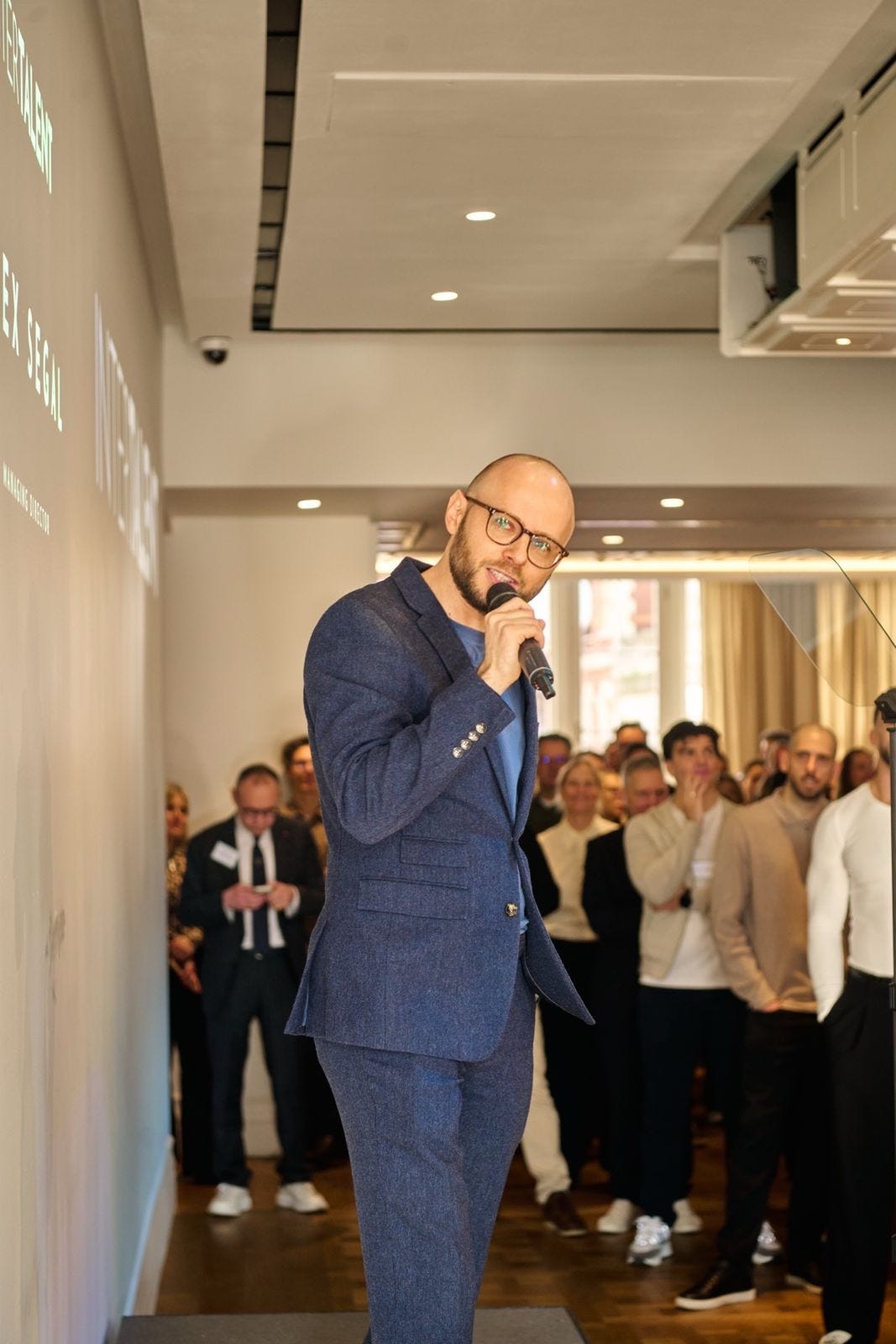
Writing a speech about the new levels of success we’ve had over the past year and the people who have helped us get there really made me start to reminisce about when I first walked into InterTalent 14 years ago in 2012.
I’ve written about my career journey before (here), but when I left ARG to join InterTalent, life was very different. I was 26. I’d been hired as an agent when I had only been an assistant before. The company was very different to what it is today, in every way imaginable. I had hair. Lots of it.
The thing that really hit home while writing my speech was that I turned up with nothing. I had no clients. I started on Day 1 with a client list of ZERO. No clients, no jobs, no commission. It was daunting, scary, and it felt like an impossible task. I was so excited to join the company but petrified of not living up to expectations. I was coming from another major agency, and all eyes were on me.
Starting a client roster from scratch is not easy.
People are either promoted to agent from within or join a new company without being able to bring anyone with them.
Day 1: no clients.
What now?
Most agents looking to build a roster from scratch just run at anything and everything. Build a list quickly. Just sign people. That’s the worst thing you can do.
I didn’t do that.
I had a plan.
Thankfully, the plan worked.
Writing my speech made me realise that now is the time to share those secrets.
Let’s go. ↓

If you’ve been reading Dealmakers for a while, you know I make every task proactive. I try not to do things that are key criteria for an agent mindlessly. Or impulsively.
➡️ Here is what you should do if you are building your client roster from scratch…
🧘 STAY CALM: First things first: do not panic. It’s daunting to realise you’re an agent without clients. That is not a place any agent wants to be in. You can feel like you’re miles behind everyone else. That pressure is real, and you may have additional pressure from within to build quickly. But if you stress about it, you’ll make poor decisions. You can go and sign people, there’s talent everywhere, but they won’t be right for you long term, and sooner rather than later, you’ll be regretting having them on your roster. You’ll be wondering why you did it, and be full of what I call signing regret. Once that creeps in, you’re already mentally working out how to let them go. That’s not a great place to start.
Desperation signing is a real thing.
Panic signings will come back to haunt you.
Don’t fall into the trap.
You do not need clients by Day 2. Or even Day 10. You do need them soon. I won’t pretend you can go months without any clients and expect to get away with that, but there is a huge difference between moving with urgency and moving with panic.
Make a plan.
Here’s what can help…
🎨 GREAT TASTE: I read and listen to some of the most successful talent agents in the world whenever they are interviewed. They always get asked the same question. ‘What makes a great agent?’ Do you know what the first thing they all say is? Taste. They ALL say it. Being decisive as to the kind of talent you love and are passionate about working with is hugely important. Having great taste is a non-negotiable.
Most new agents make the same mistake at the start: they just try to sign anyone good. When you’re building from nothing, the temptation is to just get some good people signed up. But your first few signings dictate so much. More than you might even realise. They immediately tell others what kind of roster you’re building. They tell people what level you’re aiming at.
Don’t scatter-gun sign at the start purely to have a list. It’s an easy trap to fall into, but it could actually harm you more than help you in the long run. Know exactly what kind of agent you are, and what kind of roster you're building. Taste is a strategy, not just a preference.
🔎 ACTIVE SCOUTING: I wrote a whole piece on this here, so I won’t go into it too much. Please take a read. Some people wait for a star to just appear. By chance. A lucky scroll on TikTok. Others are more targeted; they’ve done their homework, they know what they’re looking for, and nothing is left to chance. Who is under-represented? Under serviced? Under valued?
You are probably not going to sign the hottest name in the room at the start of building your roster. The real gold is finding the person who has been looked over, who has had a rough patch, who is between chapters but has the talent. Or the one who is super talented but hasn't had the right agent yet (you!). Be an active scouter. It will ensure that you don’t scatter-gun sign, and actually focus you on who you really want. If you’ve done the work upfront, you should know what the industry will want in 12 to 18 months, not just guessing.
The agents who build fast are the ones who are watching everything. Showcases, short films, open mic nights, YouTube channels, comedy shows, TikTok accounts. Whatever your world is, you need to be the person who sees talent 6 months before everyone else does. Go looking with intent.
Active scouting will keep you calm and focused in a moment that can be panicky and pressured.
📖 STORYTELLING: This is the most crucial thing to consider. When you have a client list, and you come armed with results, reputation and a killer client list, the story you sell to potential new clients is a lot easier. You can talk about who you represent and what you’ve achieved. The story of ‘WHY ME?’ (which is what every agent has to answer really bloody well when pitching to a new talent) has a head start.
But what if you don’t have any of that? The ‘WHY ME?’ becomes a lot harder, and the story becomes everything.
The best agents are always the best storytellers.
Every potential client is silently asking the same question: Why should I trust you with my career?
You have to paint a picture without having any data to back it up. You have to sit in front of a potential new client when you have nothing to show them, and convince them that even without a client list, you are the perfect person for them, and they should absolutely be your first (or one of your first) clients.
You need to really think about how you are going to convince someone to take a chance on you. You have to paint a picture without much evidence. You have to sit in front of someone, sometimes with almost nothing tangible to show them, and convince them that even without a roster, you are the right person for them.
The story you tell to convince them is incredibly important. This is where you really sell yourself. One of the most important things an agent does is sell. To be really good at selling, you need to be an excellent storyteller.
You need to paint a picture that is interesting, intriguing and exciting enough for the other person to say YES. It’s what I do all day, every day, but in this scenario, it’s more important than ever. You need to have an incredible ability to convince people of what you are saying.
If someone were to ask me what one of my greatest strengths is as an agent, I’d say I’m very good at storytelling. It’s a performance all day, every day. An art form. I love painting a picture well enough that the other person believes in it.
Really know your story. Really know how you are going to sell yourself. You have nothing else to rely on at the start other than your ability to convince another person that they should put their career in your hands.
Clients don’t just buy your experience. They buy your vision. So really know your story. Really know your pitch. Really know your ‘WHY ME?’
🤝 BE REAL: In addition to being a great storyteller, the temptation when you’re really desperate to get a great client to join is to overpromise. Or lie. Don’t. Promising the world when you’re just starting out is the fastest way to blow up your reputation before it’s even formed. Instead, be direct: “I’m building my roster, I believe in you enormously, and here is specifically what I think I can do for you. I can’t promise results, but I can promise work ethic.” People respect honesty.
One top agent told me he said to potential new clients at the start of his career, ‘Put your trust in me, I won’t let you down, but if I’m not right, just fire me.’ He said it was the greatest tactic he ever used, and the honesty helped him massively at the start. Why? Because it was honest. It lowered the fear for a talent signing to an agent with no other clients. It made the risk feel manageable and less scary for them.
At the start, you are not selling perfection. You are selling work ethic, vision, trust and knowledge.
📩 FOLLOW UP: Momentum is everything in this industry. Without it, life is very hard. You want to be an agent with momentum at all times. This means great relationships, clients, opportunities, results, everything. People underestimate the art of repetitive following up. It gets talked about often by serial winners. They often cite the art of following up as their greatest skill. When you’re starting to build a client list, and you reach out to someone. Whether they don’t reply or do but go quiet, then I have one piece of advice: follow up.
When you reach out to someone and they don’t reply? Follow up.
When they reply positively but then go quiet? Follow up.
When you have a great meeting and then ghost you? Follow up.
People notice who follows up, who stays in touch, who treats every conversation like it matters. Be the person who responds quickly, who keeps their word, who never wastes someone's time.
🤝 BE A CLOSER: Get the client in. I hear so many examples of young agents having 2, 3 or even 4 pitch meetings with the same talent and yet still can’t get them over the line. They’re saying the right things, but clearly something is stopping them. If you’re just starting out it’s probably the nervousness of joining a young, new agent. It’s the inexperience that worries them. You can’t go 3 or 4 rounds and not get the talent. I see people going round and round in circles.
It hurts your time.
It hurts your confidence.
And it stops you from speaking to the next person you should be focusing on.
You really need to seal the deal. There are different tactics. Set a deadline. Start unofficially representing them anyway and bring them an opportunity to show you can deliver what you’ve said. Ultimately, don’t let people mess you around. Either they’re in, or they’re not. If they’re not, have the strength to move on. They’ll sign if they really want to.
When I first started, I had 2 really talented actor friends who said they’d sign with me if I ever got the step up to agent. When I did, I went straight for them. After all, it’s what they said. I met up for numerous coffees, pitched myself well, they said all the right things too… but neither ever signed. They gave the usual ‘I do rate you, but just want to see how you get on with others’ fob off. I didn’t see it early, so I kept pursuing it and ultimately wasted a lot of my time, and it just made me disheartened.
At some point, someone is either signing or they’re not. If you’re getting to round 3 or 4 - or you're being made to wait for a lifetime - and they’re still not signing, they are not joining you. That’s the facts.
You need to learn how to close a client. Closing is a huge skill, and the difference between the best agents and others. You get better at it with experience.
Try to learn it early because agents who can’t close will really struggle to build their roster.
🚀 OVER SERVICE: If you’ve managed to get some really cool people to join your brand new client list, then well done. The hardest thing an agent has to do is sign talent. People think it looks easy. It isn’t. It’s really hard. It’s emotional. It’s competitive. It takes thick skin. So what next? The best thing you can do is over-service.
Go beyond what you said you would do for them. You need them to be the best advocate for you, and if you really go beyond what other agents would do, then they will tell the world how good you are. Treat them like a proof of concept for everyone else who could potentially follow.
The first clients on a new roster should feel like they have joined someone on a mission.
Do more than what’s expected, do more than what you even told them you would do. If you’ve worked really hard to find those first few clients, don’t just middle of the road it. Show them that you are proving yourself 10x over.
I remember my first few clients. The people who showed faith in me when I had nothing to back up my words. Their saying YES to me handling their careers, and starting my own, meant that I went to battle for them harder than I even realised I would. I wanted to return their faith and trust. Doing that enabled me to build my roster further.
Building a roster from scratch is one of the hardest things you'll do in this industry. Nobody tells you that upfront. Nobody told me. I had no clients and nothing to fall back on. It's uncomfortable, it's scary, and there will be moments where you question everything.
It’s knowing who to go for, having the patience to wait for the right people, and having the courage to move fast when you find them. Your first few signings won’t just start your client list; they could actually define you as an agent for the first chapter of your career.
I wish someone had told me all of this when I became an agent with no clients. It was sink or swim. I had to very quickly plan and have discipline.
Please pass this on to anyone who is currently in the same boat as I was 14 years ago.
📥 I would love to hear from you. Any ideas, thoughts and feedback via alex@intertalentgroup.com are always most welcome.
Please subscribe if you haven’t already, and share this with your friends.
See you next time.
Alex
Need more Dealmakers with Alex Segal? Try some of these…
💼 What is it really like to run a talent agency?
🎬 What does an Agent actually do?
Lovely Monday read - thanks for writing this up - couldn't agree more. I think being armed with knowledge is key and doing your research on the person. Clients want to feel important and loved and showing that you really do care is crucial.
First off, yes, research, I love this part, I am a proud nerd. All agents represent different people and creatives. I spend around 3-6 days going into full research mode. Who they represent, what they've done that fits my specific genre, their age never matters to me, but their previous work does, where the agent came from, their specific talent. While agents will claim to be very much behind the scenes, everything you need to know about them is fully on display *insert cheeky wink* . I've gone through hours of YouTube, social media, client lists, TV, and Films, IMDb, The Talent Manager, and more, an embarrassingly large amount of research goes into every letter, every query, every approach, and why? Agents are really busy, the last thing I want to be doing is wasting their time if they're an okay fit. I always make it personal. It's important to mention, agents are real human people, they're not gatekeepers, they're just really busy, really human, really stressed, human people. Don't waste their time with a maybe they'll want this because they like something similar?
As Alex will say, due diligence is a necessity, don't take it lightly. I don't chase, I follow, I interact, I see what else they can offer by way of learning, listening, and just showing up.